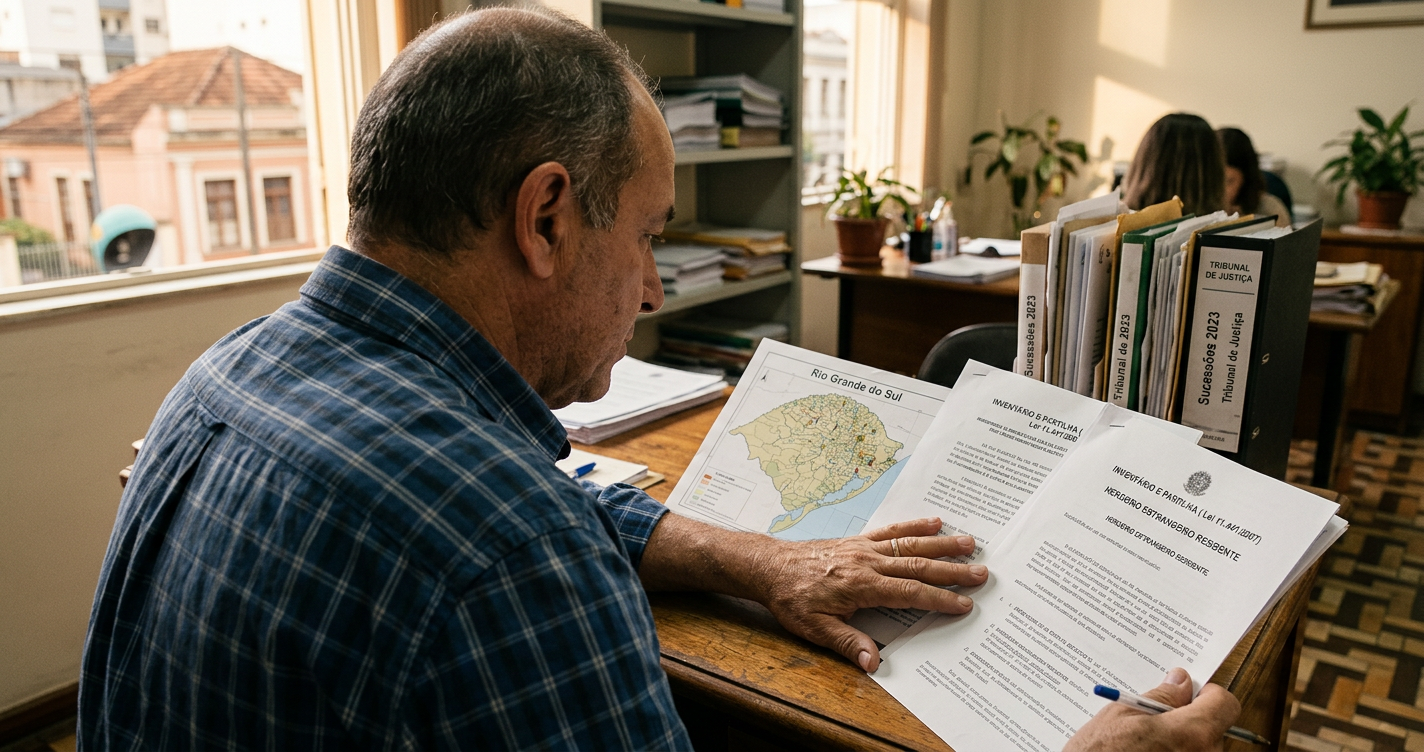

You inherit a beachfront apartment in Florianópolis worth R$ 2,000,000. You’re an American citizen, and you soon discover that Brazil wants 8% in ITCMD — R$ 160,000. Then the U.S. IRS expects estate tax on your worldwide holdings. Suddenly, two tax agencies are reaching into the same inheritance, and you’re staring at a bill that could erase nearly a third of the asset’s value. That scenario isn’t hypothetical; it’s the daily reality for cross-border families who don’t plan ahead.
Double taxation on inheritance between Brazil and other countries isn’t a bug in the system — it’s what happens when two sovereign nations each claim the right to tax the same transfer of wealth. Brazil has no specific tax treaty with most countries to prevent this overlap. Without a coordinated strategy, you pay Brazil’s ITCMD (state inheritance tax) and then your home country’s estate tax, inheritance levy, or capital gains on death — with little to no automatic relief.
This guide walks you through exactly why the overlap occurs, which countries put you at highest risk, and, most importantly, the concrete legal and administrative moves you can make to avoid or drastically reduce the double bite. You’ll see real numbers, real strategies, and the path from bureaucratic frustration to a tax-efficient transfer of your Brazilian assets.
Why Does Double Taxation Happen on Inheritance Involving Brazil?
The root cause is simple: Brazil taxes inheritance based on the location of the asset, while many home countries (especially the U.S., UK, and Germany) tax the worldwide estate of the deceased based on their residence, citizenship, or domicile. When the two rules collide, the same property is taxed twice.
Brazil’s ITCMD is levied by each state at rates up to 8%, as confirmed by Senate Resolution 57/2024. The tax applies to real estate, bank accounts, business interests, and other assets physically situated in Brazil, regardless of the owner’s nationality. Your home country then applies its own rules: the U.S. imposes federal estate tax on U.S. citizens’ worldwide assets (with a large exemption in 2026), the UK charges inheritance tax if the deceased was domiciled there, and Germany applies Erbschaftsteuer on worldwide assets if the deceased was a resident. Because there is no overarching inheritance tax treaty between Brazil and these countries, no automatic mechanism credits the Brazilian tax paid against the foreign tax owed.
Another layer of difficulty is Brazil’s forced heirship rule. Under the Brazilian Constitution (art. 5, XXXI), the law of the deceased’s home country is applied only if it benefits the Brazilian spouse or children. In practice, Brazilian courts often apply Brazilian succession law when real estate is in Brazil, mandating that at least 50% of the estate goes to necessary heirs (forced heirs). This rigidity can block the estate-planning tools that would otherwise prevent double taxation, such as lifetime trusts or carefully structured wills. For a deeper look at how this forced heirship works, see our article on Inheritance Order Brazil 2026: Who Inherits First?.
In short, double taxation happens because:
- Brazil taxes at the state level with ITCMD on Brazilian-situs assets.
- Your home country taxes worldwide assets based on your personal connection.
- No treaty automatically offsets one tax against the other.
- Brazilian forced heirship limits your ability to redirect assets through tax-efficient vehicles.
Which Countries Have the Highest Risk of Double Taxation with Brazil?
Not all home countries are equal when it comes to double taxation risk. If your country of origin has a robust estate or inheritance tax and no specific agreement with Brazil, you face a potentially confiscatory overlap. If it uses a territorial system (taxing only assets within its borders) or has no inheritance tax at all, your risk drops dramatically.
| Country | Estate/Inheritance Tax | Treaty with Brazil? | Double Taxation Risk |
|---|---|---|---|
| United States | Yes (federal estate tax, 2026 exemption ~$13M) | No | High (foreign tax credit limited) |
| United Kingdom | Yes (inheritance tax, 40% on worldwide estate) | No | Very High |
| Germany | Yes (Erbschaftsteuer, up to 50%) | No (only limited relief) | Very High |
| France | Yes (droits de succession) | No | High |
| Canada | No inheritance tax (deemed disposition on death, capital gains) | N/A | Moderate (capital gains tax, not estate tax) |
| Australia | No inheritance tax | N/A | Low |
| Portugal | Only on assets in Portugal; no estate tax on non-residents for foreign assets | N/A | Low |
| Japan | Yes (inheritance tax for residents and some non-residents) | No | High |
If you fall into the high-risk category, don’t panic — proactive planning can slash the total tax load significantly.
Administrative Solutions: How to Avoid Double Taxation Without Going to Court
Before you ever set foot in a courtroom, there are powerful moves you can make through careful estate planning and administrative filings. These strategies work precisely because they operate within the legal systems of both Brazil and your home country — sometimes simultaneously.

Strategy 1: Make Lifetime Gifts Instead of Death Transfers
Brazil taxes gifts (doações) with the same ITCMD rate as inheritances, but you control the timing. By gifting property gradually over several years, you can use annual exemptions in your home country (the U.S. has an annual gift tax exclusion of $18,000 per recipient in 2026) and stagger the Brazilian tax impact. Take a German retiree who owns a R$ 2,000,000 apartment in São Paulo. She gifts 50% to her daughter (a German resident) in 2026, paying 4% ITCMD — R$ 40,000 — based on the state rate. In 2028, she gifts the other half, paying another R$ 40,000. When she dies in 2032, no Brazilian inheritance tax is due on that apartment because it’s already transferred. Meanwhile, in Germany, the lifetime gifts may fall under progressive exemptions if properly structured, reducing the overall German inheritance tax bite.
This strategy works best when you start early. The key is to stay under the donor’s home country lifetime gift exemption and respect Brazilian forced heirship rules — a gift that infringes your spouse’s or children’s legitimate share can be challenged later.
Strategy 2: Use a Brazilian Holding Company (Holding Patrimonial)
A holding patrimonial is a Brazilian limited company (usually an LTDA or S.A.) that holds your real estate and other assets. Instead of owning the beach condo directly, the company owns it, and you own the company’s shares. When you pass away, your heirs inherit shares of a Brazilian company — not the real estate itself.
Why does this matter? Two reasons. First, the valuation of shares may differ from the appraised market value of the property, potentially reducing the ITCMD base (though tax authorities may challenge aggressive undervaluation). Second, many countries tax shares held by a non-resident differently. A U.S. citizen, for example, might treat the shares as intangible property that can be structured to fall under a lower bracket or take advantage of foreign tax credits more easily than a direct real estate asset. There’s no guarantee, but it opens planning doors that bare ownership closes.
Setting up a holding patrimonial involves drafting a contrato social, registering the company at a cartório, obtaining a CNPJ, and transferring property to the company. Legal and registration costs typically start at about R$ 8,000 to R$ 15,000, but the savings on a multi-million real estate portfolio can dwarf that expense. You’ll need a Brazilian lawyer and accountant to keep the corporate veil intact and ensure compliance with the Receita Federal.
Strategy 3: Establish a Revocable Living Trust (If Your Home Country Recognizes It)
Brazil has no domestic trust law — it’s a civil law country — but Brazilian courts and tax authorities do recognize foreign trusts under private international law, specifically Article 9 of the Lei de Introdução às Normas do Direito Brasileiro. If you are a national of the U.S., UK, Australia, or another common law jurisdiction, a revocable living trust created under your home country’s laws can hold title to your assets. That trust can specify distribution without triggering Brazilian probate (inventário) and may minimize ITCMD because the legal ownership has shifted.
However, the Brazilian tax authority may still claim ITCMD on assets located in Brazil, arguing that the beneficial owner’s death triggers a transmission. Whether you can avoid Brazilian taxation entirely depends on the trust structure and the specific state’s interpretation. A well-drafted trust, combined with a Brazilian legal opinion, can give you a defensible position and delay the tax event. You will still need a local attorney to handle the cross-border recognition. The cost of setting up a foreign trust for Brazilian assets is substantial — expect R$ 15,000 to R$ 30,000 in combined legal fees — but for estates above R$ 3,000,000, the tax savings often justify it.
Strategy 4: Claim Foreign Tax Credits in Your Home Country
If you’re reading this after the death has already occurred, your strongest postmortem tool is the foreign tax credit offered by some countries. The U.S., for instance, allows a limited credit on Form 706 (estate tax return) for estate tax paid to a foreign government. If the Brazilian state charged you 8% ITCMD on a R$ 2,000,000 condo, you paid approximately R$ 160,000 (around $32,000). The U.S. estate tax would calculate a tentative tax and then subtract that foreign credit, up to a limit. The credit only reduces the U.S. tax liability — it doesn’t refund the Brazilian tax — but it ensures you aren’t taxed twice on the same amount.
Filing for the credit requires meticulous documentation: the official ITCMD payment receipt (guia de recolhimento), probate court documents, translated appraisals, and a sworn translation into English. You’ll need a cross-border accountant. This administrative process avoids litigation entirely, but missing a filing deadline — such as the U.S. 9-month window — can lose you the credit forever.
Strategy 5: Renounce or Disclaim the Inheritance
In extreme cases where the total tax bill exceeds the net value of the asset you’d actually receive, you might consider renouncing the inheritance. Brazilian law allows an heir to formally disclaim (renúncia) the inheritance through a public deed at a cartório or before a judge. If you do this cleanly, you never acquire ownership, and no ITCMD is imposed on you. The asset passes to the next heir in line, who may face a lower tax burden. This strategy is rarely used but can be a lifesaver when the numbers don’t add up.
The Judicial Path: When Court Becomes Necessary to Avoid Double Taxation
Administrative planning works in the majority of cases, but sometimes you’ll find yourself in a dispute that only a judge can resolve. The most common scenarios that land in Brazilian probate court (inventário judicial) involve:
- Disagreement over asset valuation: The state tax authority may overvalue a property, raising the ITCMD base and, by extension, your double tax exposure. You can challenge the valuation administratively first, and then in court, presenting a new appraisal.
- Recognition of a foreign trust or will: If your home country’s estate plan conflicts with Brazilian forced heirship rules, Brazilian courts must decide whether to recognize the foreign instrument. For example, a trust that excludes a forced heir may be partially invalidated in Brazil, altering how and when ITCMD is levied.
- Disputes over tax exemptions: Some states grant limited ITCMD exemptions for small estates or for transfers to a surviving spouse. If the tax office denies your exemption claim, you can bring an action to enforce it.
Judicial probate in Brazil takes time — typically 12 to 24 months if uncontested, and years if adversarial. Legal fees follow the OAB table, often 5% to 10% of the estate value. Court costs average 1% to 3% of the estate value, depending on the state. A foreigner will also pay sworn translation fees (R$ 150 to R$ 400 per page). For a R$ 500,000 estate in São Paulo, you might spend R$ 5,000 in court costs and R$ 25,000 to R$ 50,000 in legal fees — not counting the ITCMD itself. If the dispute prevents a double-taxation disaster, the expense is worth it. But you should enter this arena only after exhausting administrative routes.
One noteworthy judicial lever: if your home country’s law is more favorable to Brazilian heirs, the Brazilian court will apply that law under the constitutional provision. You may argue that applying foreign law reduces the overall tax burden, indirectly mitigating double taxation. Working with a skilled Brazilian lawyer can make this argument persuasive.
Common Mistakes That Worsen Double Taxation
- Assuming your home country’s tax credit covers everything: The U.S. credit is non-refundable and capped. If your Brazilian tax bill is larger than your U.S. estate tax, you eat the difference.
- Forgetting that Brazilian forced heirship limits your will: You can’t simply leave assets to a trust or a non-heir child; Brazilian heirs can claim their legítima, dislodging your planning and creating a double tax event.
- Waiting until after death to plan: Lifetime gifts and holding companies must be set up while you are alive and competent. Postmortem planning is extremely limited.
- Not obtaining a Brazilian CPF for the estate: Without a CPF, you cannot open the probate, pay ITCMD, or transfer property. Many foreigners delay this step and miss critical deadlines.
- Using a do-it-yourself approach: Brazilian cartórios and tax offices require specific forms (the guia de recolhimento), notarized signatures, and sworn translations. A single missing stamp can stall the process and expose you to interest on the ITCMD.
Frequently Asked Questions About Double Taxation on Inheritance in Brazil
I’m a U.S. citizen inheriting a Brazilian apartment. Do I have to pay both Brazilian ITCMD and U.S. estate tax? Yes, unless planning reduces the impact. Brazilian ITCMD applies to real estate in Brazil, typically 4% to 8% of market value. The U.S. imposes estate tax on your worldwide assets (2026 exemption ~$13 million per individual). You can claim a foreign tax credit on IRS Form 706 for the ITCMD paid, which reduces your U.S. liability but doesn’t refund the Brazilian tax. If the U.S. estate tax on that property is lower than the ITCMD, you may still end up with a net double cost because the credit is nonrefundable. Early gifting or a holding company can lower the taxable base in both jurisdictions.
Ready to Avoid the Double Taxation Trap? Get Expert Legal Help
Cross-border inheritance is one of the most emotionally draining and financially treacherous areas of the law. The feeling that you’re being punished for the same asset by two governments is not only frustrating — it can wipe out a third of the wealth your family member worked a lifetime to build. Yet the right moves, taken at the right time, can shield your Brazilian inheritance from that fate.
Our bilingual team at Ribeiro Cavalcante Advocacia understands both Brazilian bureaucracy and the expectations of foreign heirs. We help you structure holding companies, file foreign tax credit claims, navigate cartórios, and — when necessary — represent you in Brazilian probate court. Whether you’re planning your own estate or you’ve just found yourself listed as an heir in Brazil, we can turn confusion into a clear, executable plan.